Orange on the Block

Looking for early signs of autumn, I decided to photograph the color orange in our neighborhood. It turns out that it was mostly in our own front yard.

Our neighbor’s crabapple tree with the tiniest fruit …

Miniature rose recovering from the summer’s heat by producing a perfectly formed little bud …
Oakleaf hydrangea foliage starting to turn …

Rust-colored chrysanthemums …

“Living Easy” rose, vibrant as ever …

Our new sign …

Leaves from our Linden tree, fallen before fulling turning …

Pyracantha berries across the street …

Early pumpkins …

But don’t let me rush things!


Italian Seasonings

After yesterday’s harvesting and drying of herbs, this morning I found myself thinking about to what uses I wanted to put them. Most of them I will just store plain, but  I will probably make some seasoned salts and after breakfast I did make a batch of Italian Seasonings. (Recipe below.)  The golden oregano, thyme, rosemary and chenzo pepper were from my garden. Except for a few leaves here and there – not enough to merit drying – my basil is already gone for the season.

There are quite a few variations in recipes for Italian Seasonings. Some have majoram, parsley and/or savory. Many don’t have the hot pepper. Here is the recipe that I use.

Ingredients:

4 T. dried basil

4 T. dried oregano

1 T.  granulated garlic

1 1/2 t. dehydrated minced onion

1 1/2 t. dried thyme

1 1/2 t. dried rosemary

1/2 t. dried hot red pepper

Pulse ingredients in a small food processor until desired consistency.

As you can imagine, after producing a batch of Italian Seasonings, I had to make something Italian with it! And luckily for me, I had some fresh vegetables in the house that I needed to use. So for lunch we had polenta with romano cheese and a thick, tasty tomato-pepper sauce. Now I need a nap! Ciao!

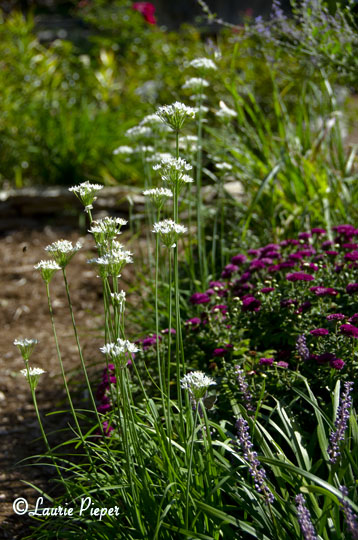
Garlic Chives: Let the Harvest Begin

Garlic Chives (allium tuberosum) are one of those plants with which I have a love-hate relationship. I love the way that they look  in bloom and the way that their flowers help fill the gap between summer and autumn in the garden. But garlic chives are one of those plants that are not happy staying put. They spread themselves all around the landscape. Fortunately, they have culinary uses. (A rather pungent herb with a flavor akin to garlic and onions, garlic chives can be used in stir fries, soups, and stews.) Since mine are just on the verge of going to seed, for the past few days we’ve been yanking them out of the garden except the few spots where they are wanted. Then we’ve been sorting through it all, removing stems, roots, and damaged leaves, washing the healthy leaves, and putting them in the  oven to dry. Since the pilot lights in my ovens are always on, the ovens never cool below 110 degrees F. which makes them perfect for this use. Once the garlic chives are completely dried out, I will chop, bag, and store them in the freezer until ready to use. I find that herbs keep their color best this way. I’ve read that garlic chives lose their flavor once allowed to flower, however, to me they seem plenty flavorful; and besides, I just couldn’t let them take the space they have appropriated in my garden if I didn’t let those striking white clusters appear.

Stuffed Pumpkin Butter French Toast

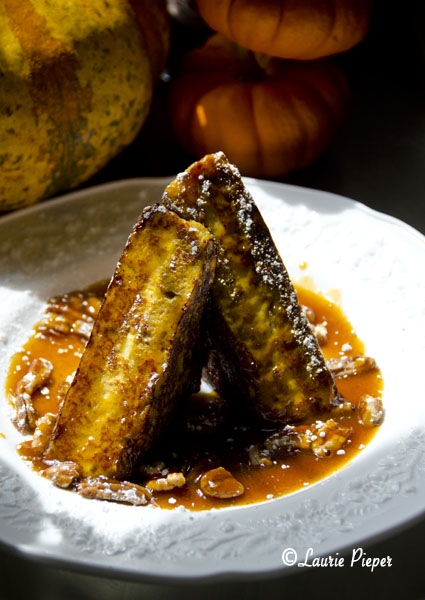
In yesterday’s Pumpkin Butter post, I said that I would be serving Pumpkin Butter for breakfast this morning.  Keeping my word, this morning’s special was Stuffed Pumpkin Butter French Toast. I know. There is nothing French about this dish; but it is what Americans call “French Toast”.  Whatever the origins … yum! It tastes like autumn is here!

For 2 servings:

4 thick slices cinnamon bread, edges trimmed

3 T. low-fat cream cheese

1 lg. egg

1/4 c. half-and-half

1/4 c. + 3 T. pumpkin butter, divided

3 T. maple syrup

1/4 c. pecans or walnuts

confectioner’s sugar for serving

(1) Spread cream cheese on 2 of the slices of bread. Top with remaining bread. Cut each “sandwich” diagonally into 2 triangles.

(2) Beat together egg, half-and-half, and 1/4 c.  of the pumpkin butter until perfectly smooth. Soak triangles in batter for 2 – 3 minutes on each side. Make sure that the edges are coated with batter.

(3) Preheat a skillet or grill over medium heat until a drop of water sizzles but does not skate across the surface. Coat with butter, canola oil, or vegetable spray. (Butter and vegetable spray work fine in a non-stick skillet, but when I make French Toast on our commercial grill, I use canola oil.) Grill bread on each side for several minutes or until egg is cooked and lightly browned. Remember to grill edges as well.

(4) Meanwhile, stir together remaining 3 T. of pumpkin butter and the maple syrup. Warm just before serving.

(5) Arrange nuts on 2 serving warm plates. Arrange French Toast. Drizzle with pumpkin syrup and then dust with confectioner’s sugar. Serve right away. Enjoy!

Pumpkin Butter – ‘Tis the Season

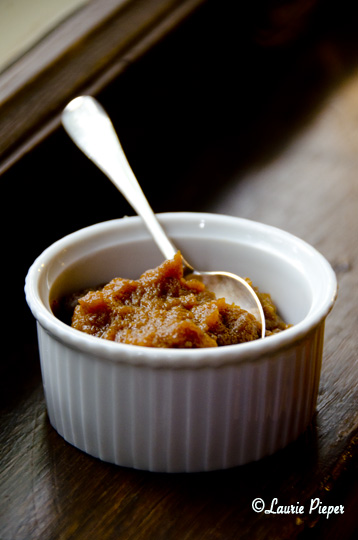
The hot weather has finally broken. It is rainy and in the 50’s here today. To make the house feel warm and cozy, I decided to make some aromatic Pumpkin Butter which I can serve for breakfast tomorrow. Oh, yum. This both smells so good while it is cooking and tastes delicious!In a heavy-bottomed pan, combine the following ingredients:

3 1/2 c. pumpkin puree

1 c. honey

2 T. lemon juice

1 T. ground Vietnamese cinnamon

1/4 t. ground cloves

1/4 t. ground mace

Stirring occasionally, cook over very low heat for about 45 minutes or until very thick and smooth. Store in the refrigerator, in glass jars,  for up to 2 weeks. Makes 1 quart.

Pumpkin butter can be served on breads, on top of yogurt, or used to fill tarts.

Piquant Pieper Sauce and Pieper Eggs

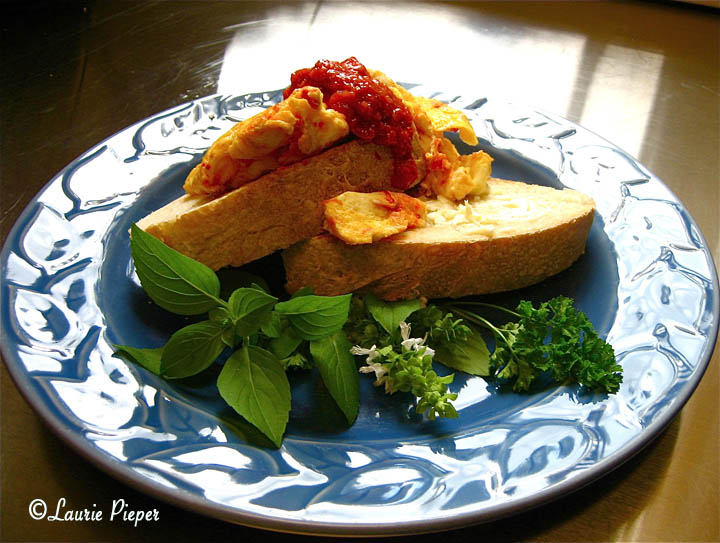
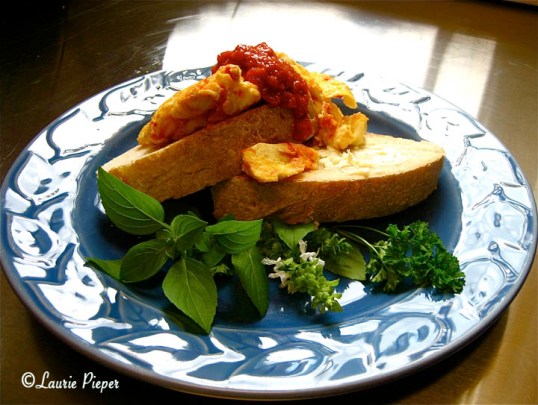
My husband always tells me that the one draw back to my recipes is that I am not sufficiently creative when it comes time to name them.  Despite the unimaginative name -when writing my first cookbook, I ran out of appellations and named this dish after myself – this is quite delicious. It can be served warm or cold to top eggs, tofu, pasta or pizza. It can also be served as a dip for French bread, pita bread or chips. Shown below, Pieper Eggs … what else?
Piquant Pieper Sauce

4 lg. ripe red bell peppers

1 1/2 c. tomato sauce (unseasoned)

1/2 c. chopped white onion

1 jalapeno pepper

1 T. extra virgin olive oil

1 T. granulated sugar

2 to 3 T. fresh lemon juice, divided

2 t. paprika

1 t. salt

1/4 t. salt

1/4 t. fresh ground pepper

1 pinch ground thyme

1 clove garlic, crushed

(1) Preheat oven to 425 degrees F. Line a baking sheet with parchment paper. Arrange peppers on parchment paper. Place baking sheet in the oven and  roast peppers, turning them occasionally with a pair of tongs, for about 20 minutes or until their skins are very blistery. Place peppers in a paper bag. Close the bag and let the peppers cool for 10 to 15 minutes or until they are cool enough to handle.

(2) Meanwhile, wearing plastic gloves, remove the stem and then chop the jalapeno. Place jalapeno in the bowl of a food processor.

(3) Working over the food processor bowl, peel the peppers, removing as much of the skin as  you can. Remove the stems and slice the peppers open. Remove and discard the seeds. Place peppers in the bowl of the food processor.

(4) Add remaining ingredients, starting with just 2 T. of the lemon juice. Process until almost smooth.

(5) Preheat a large, heavy skillet over medium heat. Pour the sauce into the skillet and cook for about 20 minutes or until the liquids have cooked off and the sauce is very thick. Stir frequently. If the sauce begins to spatter while it is cooking, reduce the heat.

(6) When the sauce is thickened, taste to see whether it needs more lemon juice, salt or pepper. Adjust seasonings if necessary. Use right away or store in the refrigerator in a covered glass jar. Yields about 1 quart.

Pieper Eggs

(per serving)

1 t. unsalted butter

2 lg. eggs

1 T. milk

3 to 4 T. warm Piquant Pieper Sauce, divided

2 slices French Bread, warm and buttered

1 c. baby spinach, optional

1 T. chopped fresh parsley

(1) Preheat a skillet over medium heat. Add butter and swirl it around the skillet. When butter just starts to sizzle, the skillet is ready.

(2) Meanwhile, beat together the eggs and milk. When the skillet is ready, pour in the eggs. Let eggs start to set on the bottom. Use a turner to pull them toward the sides of the skillet. Repeat, without stirring constantly, until the eggs are about half-cooked. Add 1 t. of sauce to eggs and continue to scramble until they are set.

(3) Place French bread on a warmed plate. Optionally, top with spinach. Then top with eggs. Garnish with remaining warm Piquant Pieper Sauce and then parsley. Serve immediately.

Variation: add 1/4 c. shredded mild cheddar cheese to eggs while they are cooking.

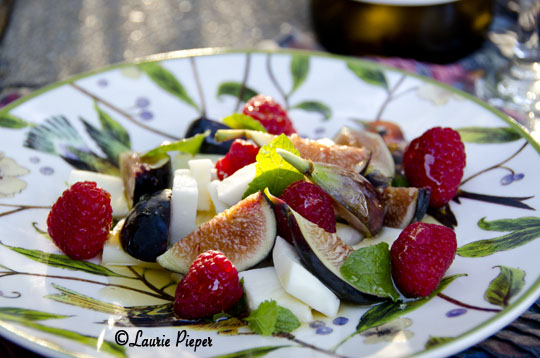
Fig & Raspberry Salad

Making the most of the last days of summer …

Fig & Raspberry Salad

Lightly toss together:

Fresh figs, sliced in half lengthwise

Fresh raspberries

Fresh mozzarella, cut into small slices or chunks

Fresh mint leaves

Drizzle with:

honey

rice wine vinegar

Serve right away.

Happy Accidents or What to do With Fragrant Phlox

When working in the garden the other day, I noticed that my Fragrant Phlox (phlox paniculata) was blooming in some unexpected places. While quite lovely, once it is done blooming, I’ll yank it up so that it does not become established where it is not supposed to be.

Here it is growing up through the edge of one of my Beauty Berry bushes (callicarpa americana) …… and here it is growing too close to one of my rose bushes (variety unknown).
Fragrant phlox likes to move around in a garden, though it is certainly not the worst offender in that regard. I find that rigorous dead-heading keeps it mostly under control. And when it does appear somewhere unwanted, it is easy enough to eliminate. I tend to let it bloom once anywhere that I like the look of it – and then yank! Afterall, I don’t want it taking over my other plantings. But in the meantime, occasionally it is nice to enjoy some of nature’s accidental pairings.

WeeklyPhotographyChallenge: Near and Far

The Big Blue River, which runs from central Nebraska into Kansas where it intersects with the Kansas River east of Manhattan …

Named the Great Blue Earth River by the Kansa Indians, the Big Blue must in recent history have actually ran blue instead of murky brown-green. In the shadows, one can still see what it may have looked like.

A freight bridge, crossing the Big Blue … where do those trains go?

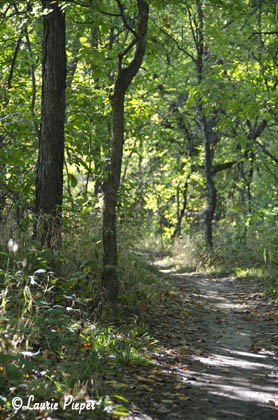
Just feet away, one can look skyward and get lost in the trees.

I took these pictures on one section of the Linear Park Trail which circles Manhattan. There are a few places on the trail where one thinks, “I can see the trees and trail before me, but where does the path lead? Will it take me far?”