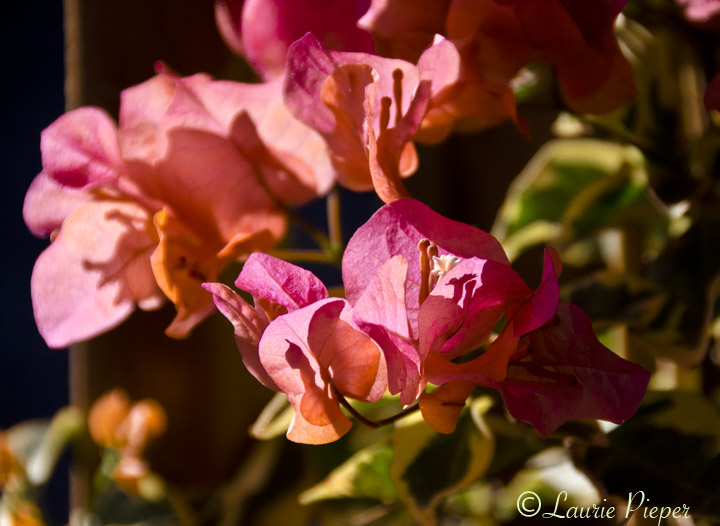
Bougainvillea is rather exotic for this part of the country. So before now, I have not tried growing it in Kansas. Through her gorgeous photographs of these plants, Sofi from Arabica really got me thinking about how much I miss tropical bougainvilleas. When I lived in California, I loved seeing these colorful plants climbing in all kinds of places. So last week I purchased a petite specimen called Bengal Orange at one of our local garden centers. Bengal Orange supposedly only gets to be 18 inches tall but can grow up to 8 feet wide. I planted it in a terra cotta pot and am going to try to train it to grow along our “back porch” – a tiny space off my office where I do container gardening. The bougainvillea is a bright and cheerful addition. Thank you Sofi for the inspiration! I’ve since come across several other posts about bougainvilleas that I have “liked”: Smell the Flowers, Ramblings by Robin Scanlon, Gardening in the Lines, and The Make Shoppe. Here are a few photos of Bengal Orange. Oh, and since pretty Penny was keeping me company while I planted it, I had to include a picture of her too.
Tag Archives: Gardening
Hydrangeas Living on the Edge
At the edge of our next door neighbor’s property, just touching ours, are two hydrangeas. Jean – a previous owner of that property and the woman who planted these bushes – told me that they are Nikko Blues.* To show their intended color, Nikko Blues require applications of acidic fertilizer when they are grown in alkaline soils such as we have in Kansas. Unless the ph of the soil is lowered, the color of Nikko Blues is unstable, ranging all the way over to dark pink. No one fertilizes the bushes next door anymore. Nevertheless, they have a beauty of their own. Unlike their showy true blue relations, these are subtle and sweet-looking, blooming away in the shade. The photos below are ones that I took yesterday. They are all of flower clusters on the same bush.
* To be honest, I am not certain that these are Nikko Blue Hydrangea bushes, though I am inclined to trust Jean. I have been reading up on the subject on hydrangea identification and am thoroughly confused. These are most definitely not Oakleaf, Lacecap or Annabelle Hydrangeas – which leaves Mopheads and Paniculatas. (Nikko Blues are Mopheads.) The leaf formation rules out the Paniculata family; but the flowers open white and then turn a pale pink or blue, which would seem to rule out the Mophead family. Plus they don’t seem to have a full “mophead” – though I suppose this could be due to growing conditions. If anyone has any thoughts on identifying these bushes, I would be happy to know them. We have 6 hydrangeas in our yard, but I don’t consider myself an expert hydrangeas at large. Whether Nikko Blues or something else, I am always happy to see these bushes in bloom.
Crape Myrtles After the Rain
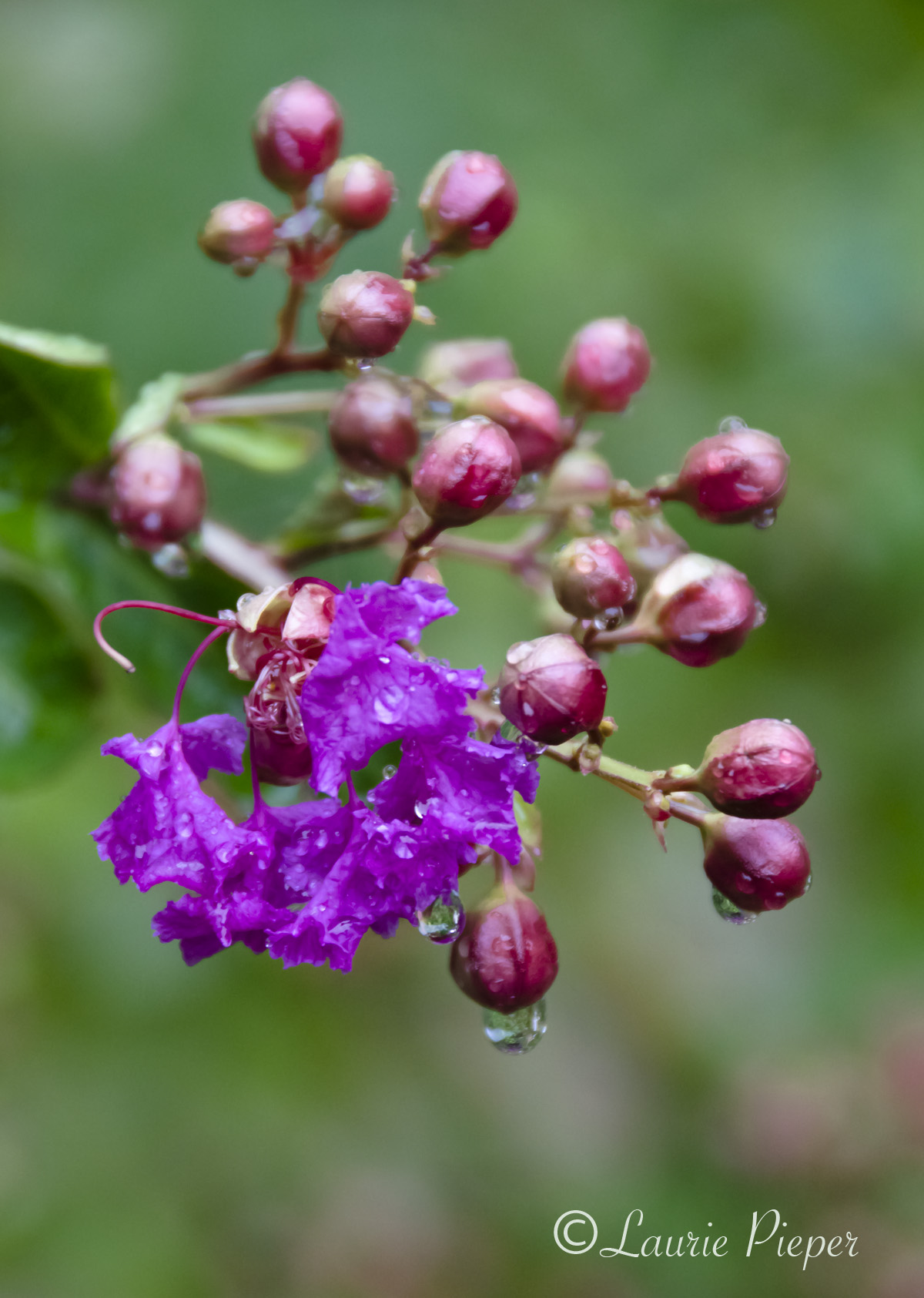
Along with almost everything else in the garden this year, our Crape Myrtles have now started blooming about a month early. After the mild winter that we had in Kansas, the die-back on the Crape Myrtles was almost non-existent. Some years the die-back is quite severe and we have to cut the trees/bushes to the ground. We received 1.27″ of rain last night. This as made everyone happy, especially the farmers, as prior to that we had received only .01″ of precipitation this month. With the garden all wet this morning, I tried to get a couple of pictures. These are of are buds and blooms on Crape Myrtle “Royalty” – one of my favorite plantings.
Let the Inspiration In
The Let the Inspiration In Challenge
I’ve gotten so that I love skimming through blogs looking for beautiful photos, tempting recipes, interesting articles, and stopping to read the ones that I like . There are so many posts that I have made a mental note to go back to. Oh, but when? I have so much to do. Yet, I recognize that I will be missing something in what these talented people – whose works I like – are writing about unless I take the time to actually let it move me to do something; and I would like to make that effort even though I’ll never get to everything. Hence my challenge to Let the Inspiration In! (If someone else is already running such a challenge, I guess that we are just thinking alike.)
If you want to join me, the details of the challenge are as follows:
(1) Once a week for a month, try out something inspired by a post that you have “liked”.
(2) The category could be cooking, gardening, photography, art, fitness, wellness, travel, etc. … but nothing crazy or dangerous.
(3) Don’t necessarily attempt to duplicate what the blogger did. For example, you might make a recipe exactly as directed or you might substitute ingredients. A photograph of a bird might make you want to go out and do some wildlife photography … or even write a poem. An article about travel might inspire you to plan a vacation.
(4) When you try something out, in one of your posts acknowledge the people who inspired you and post a comment on their blog(s) to let them know. (If you don’t have a blog of your own, just post a comment.)
(5) If you find the challenge fun, do it for another month!
If you try it out, let me know. I’d love to hear from you!
Mystery Blooms in the Garden
As I recently learned from Redneck Rosarian, June is National Rose Month … a perfect excuse to once again write about roses.
I have several ground cover roses in my garden. When I purchased them at least 8 years ago, they were labelled “Red”. In truth, they are more of a magenta. Anyhow, I am quite fond of them. They bloom from mid-Spring through Autumn and add a lot of color to the landscape … and they have proven hardy in Kansas. Now here is my mystery. A few weeks ago, one of the bushes, at the end of one branch, started producing clusters of pale pink roses. At first I thought that I was seeing an errant limb from Flower Carpet Pink, but both the form of the flower and the color were wrong to belong to that other rose. Upon closer examination, I could see that the pale pink blooms were definitely coming from the magenta ground cover rose bush. The flowers on the rest of the branch matched the rest of the bush. What has happened to cause this mutation? Will there be more mismatched roses? Nature is full of mysteries. Fortunately, this is a fun one.
Miniature Roses: A Gift for the Garden
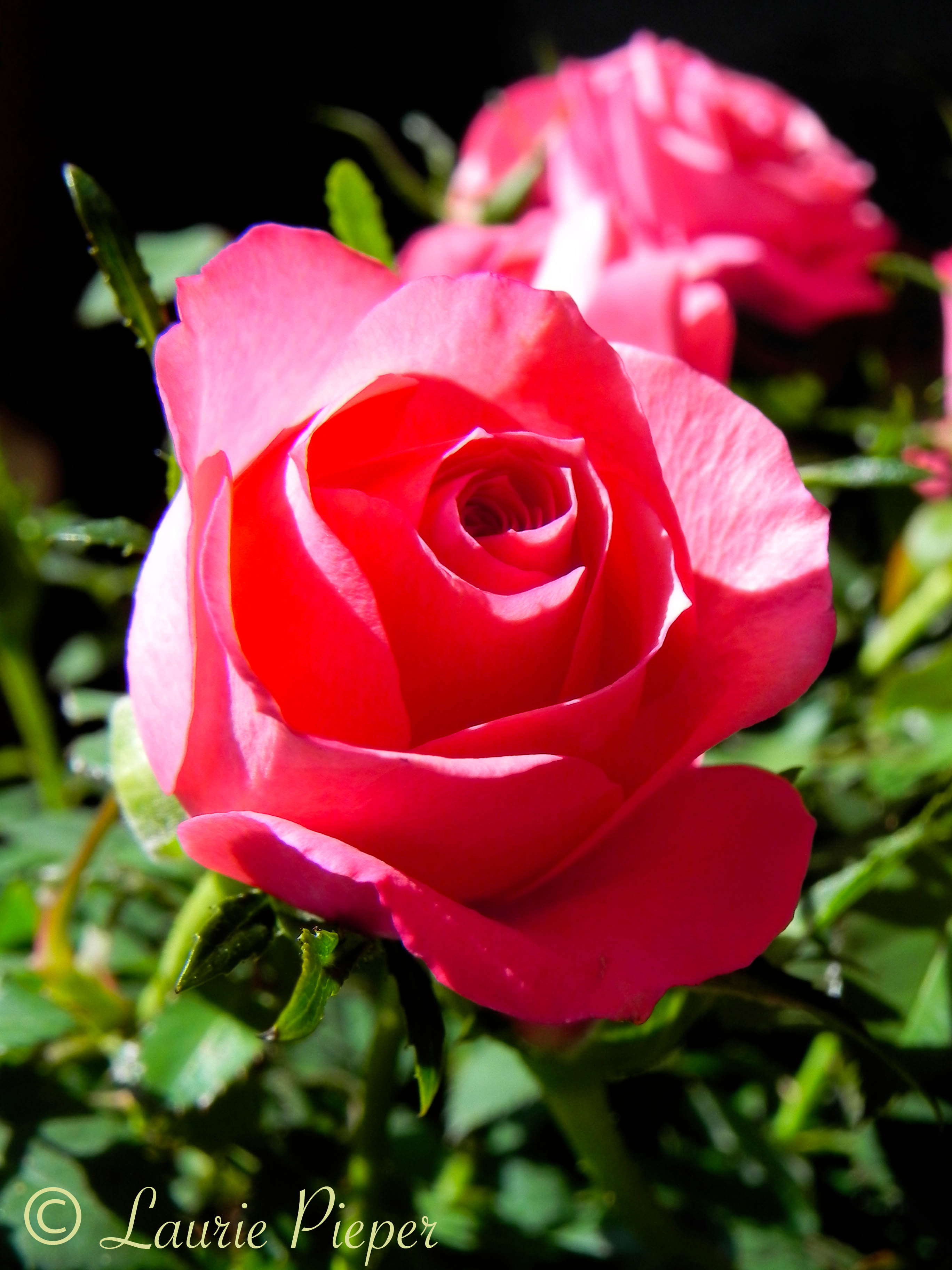
To many, it will come as no surprise that I love roses. However, I am not a rose snob. I love large, elegant, fragrant blooms and can chat away about this and that variety. When I go to a garden center, I have to examine every rose bush and ask all sorts of questions about the growth habits of each variety before I can bring one home. But I also have a penchant for buying those little potted rose plants with the tiny, highly structured flowers that sell in grocery stores for a few bucks around the holidays – a gift for my garden. When I buy them over the winter, I keep them alive inside until I can plant them outdoors in the Spring; and, they have turned out to be surprisingly winter hardy for Kansas. My oldest few have been in the garden for four years now. I have around a dozen grocery-store-bought miniature rose bushes in the garden, give or take, ranging from the most delicate pink to bright coral. I don’t know their names, but that doesn’t matter. What’s in a name?
Mint: It Grows Like a Weed, but That’s Okay
Herbs in the mint family are known to be so invasive that it is generally recommended that they be grown in pots rather than directly in the ground. A few years ago, I started a couple of large pots of spearmint by the back steps. I still have those pots of mint. Kansas winters can’t kill them off, but grasshoppers can do some damage. While the leaves are still pristine, having not yet been gnawed upon by the voracious grasshoppers that seem to plague my garden during the summer and are already appearing, I’ve decided to harvest some of the mint. So I have been thinking of its culinary uses. (In the post immediately following this I give a cocktail recipe that I created for using homemade mint products.)
Tip: To harvest mint, make sure that it has been well watered for several weeks prior to cutting. Cut mint in the morning before the heat of the day has started to set in and, preferably, cut only stems of mint that have not yet started to flower. Clean with cold water. Use only undamaged leaves.
Uses
(1) Mint Tea
Place a large quantity of leaves in a teapot. Pour fresh boiling water over leaves and let steep for about 5 minutes. Strain to serve. Variations: add lemon balm leaves, chamomile flowers, black or green tea leaves, orange or lemon peel, and so forth.
(2) Mint Simple Syrup
Add 1 cup cold water and 1 cup granulated white sugar to a non-stick pot. Heat, stirring frequently, until the sugar is dissolved. (No need to simmer.) Place 2 c. mint leaves in a large glass bowl. Carefully pour simple syrup over mint and allow to sit for 5 to 15 minutes. Squeeze juice from leaves into syrup. Stain into syrup into a glass jar.
Use in cocktails such as Mint Juleps or Mojitos. Use to sweeten lemonade or to sweeten black or herbal teas (hot or iced). Toss a small amount with fresh fruit such as honeydew or grapefruit segments for a minty fruit salad.
(3) Mint-Infused Vodka or Rum/Mint Extract
Fill a glass jar with fresh mint and top off with vodka or white rum. Cover tightly and shake. To make infused-vodka, store in the refrigerator for 24 hours. Strain out mint leaves and pour vodka into a glass bottle. To make extract, allow the mint leaves to sit in the vodka for 2 weeks before straining. While the mixture is sitting for the 2 weeks, remove any leaves that float to the top and turn brown.
Use vodka or rum in cocktails. Use extract in brownies, cookies, or whipped cream.
(4) Dried Mint Leaves
Hang bunch of leaves on stems 4 – 5″ long and hang in a warm, dry place or dry leaves in an oven or food dehydrator.
Use for teas or in middle Eastern and far Eastern dishes.
That’s all that I came up with for today. What are your favorite ways to use mint, whether spearmint or some other variety? I’d love to hear your suggestions.
Happy Mother’s Day
It has been a joy-filled few days here at The Morning Star with several large families staying with us to celebrate graduation at K-State. Also, it has been a lot of work – fun, but work. Today is Mother’s Day, which means another happy occasion, though a slower paced one.
My mother taught me to garden when I was a little girl. To this day, we still share a passion for pretty flowers and foliage. One of our favorite things to do together is to admire a well-tended garden. So for my Mother’s Day blog, I decided to take some photographs of the “Apple Blossom” Double Impatiens that I have blooming in pots along the front porch. To my mother, and all of the wonderful mothers out there, Happy Mother’s Day!


Growing and Cooking with Herbs
The Portia Club from Wamego came over today for a tour of the house and garden and a discussion of growing and cooking with herbs. They are a very lovely group of women to chat with.
Here are some of the things we talked about:
(1) Using herbs in the landscape versus growing them in pots. Some herbs such as Golden Oregano make wonderful groundcovers without being invasive. Some such as Sage are attractive accent plants when in bloom. Parsley is a good plant for butterfly gardens. Anything in the mint family, however, will have a tendency to take over the garden if not harvested on a regular basis and so should be grown in pots. The pots can be placed in the ground, though, if you want to hide the pots in the landscape. Many herbs are suitable for container gardens. Basil, Parsley, and Cilantro come to mind for potted arrangements as well as some of the fancy Sage varieties.
(2) Herbs want sun. I’ve tried growing herbs in shade to part shade. I haven’t found any that are happy with those conditions. They don’t all like heat, however. Cilantro, for example, will go to seed as soon as it gets hot. So in hot areas, late afternoon shade will help extend its growing season. Others, such as Basil, are very intolerant of cold temperatures. So don’t put basil outside when temperatures might still dip into the 40’s. Grey leaved herbs such as Sage and Lavender are more drought resistant than green leafy herbs such as basil which will need regular watering when it is hot.
(3) Overwintering of herbs. This year I left large pots of Rosemary, Oregano, and Spearmint outside over the winter. They came back fine. It was the first winter that I have had luck doing this. Two things were different from other years. One, of course, was that we had a milder winter – it was still definitely a winter with freezing temperatures, though. The other difference was that I had the herbs in large pots so I think that they had enough soil to give the roots a bit of insulation. Some people have luck bringing their herbs inside for the winter. Expect the herbs to go through a period of adjustment and make sure that they have enough sun if you are going to try this.
(4) Cooking with fresh herbs. When cooking with fresh herbs, the thing to remember is that they are fresh. Their fresh flavor is what you want to come across. I like to use them in cold sauces and dips – added right before serving. Their fresh flavor can also be harnessed by using them in compound butters – in a food processor blend softened butter and herbs with citrus zest, citrus juice and/or spices. Wrap tightly in plastic wrap and refrigerate. If using herbs in a cooked sauce, add them right at the end of cooking to get the best flavor.
(5) Other ways to capture flavor. The flavor of herbs can also be preserved by using them to flavor simple syrups and vinegars. (See my post, The Underrated Chive.) Simple syrup is made by heating sugar and water (either equal parts or twice as much sugar as water) until the sugar is dissolved. Herbs, such as spearmint or lemon balm, can be added during the cooking and allowed to sit in the syrup for about 20 to 30 minutes after removing from heat. They should then be strained out before the syrup is bottled. Simple syrups can be used to flavor drinks such as iced tea or cocktails or to flavor desserts. Flavored vinegars can be added to salad dressings and sauces.
(6) Drying herbs. Generally herbs should be harvested before blooming – unless it is the blooms that you are harvesting – and before the weather starts to turn cool. The real key to drying herbs, though, is to dry them quickly so that they don’t rot before they are dried out. Herbs such as Rosemary, with a lower moisture content can be suspended in small bunches in an airy, dry space out of direct sunlight. For herbs with a higher moisture content, such as Parsley, the method with which I have had the best luck is spreading the cleaned leaves out on a large baking sheet and placing them in the oven using just the pilot light or the lowest heat until the moisture has evaporated. Then I transfer them to a zip top freezer bag and freeze. Some herbs such as chervil, however, just don’t dry well.
Happy gardening! Happy cooking!
Top photo: Sage, Rosemary & Oregano
Middle photo: Golden Oregano by Day Lilies
Bottom photo: Potted Herbs (Sage, Thyme, Oregano, Thai Basil, Tarragon)
Cinco de Mayo Roses: A Festival of Color
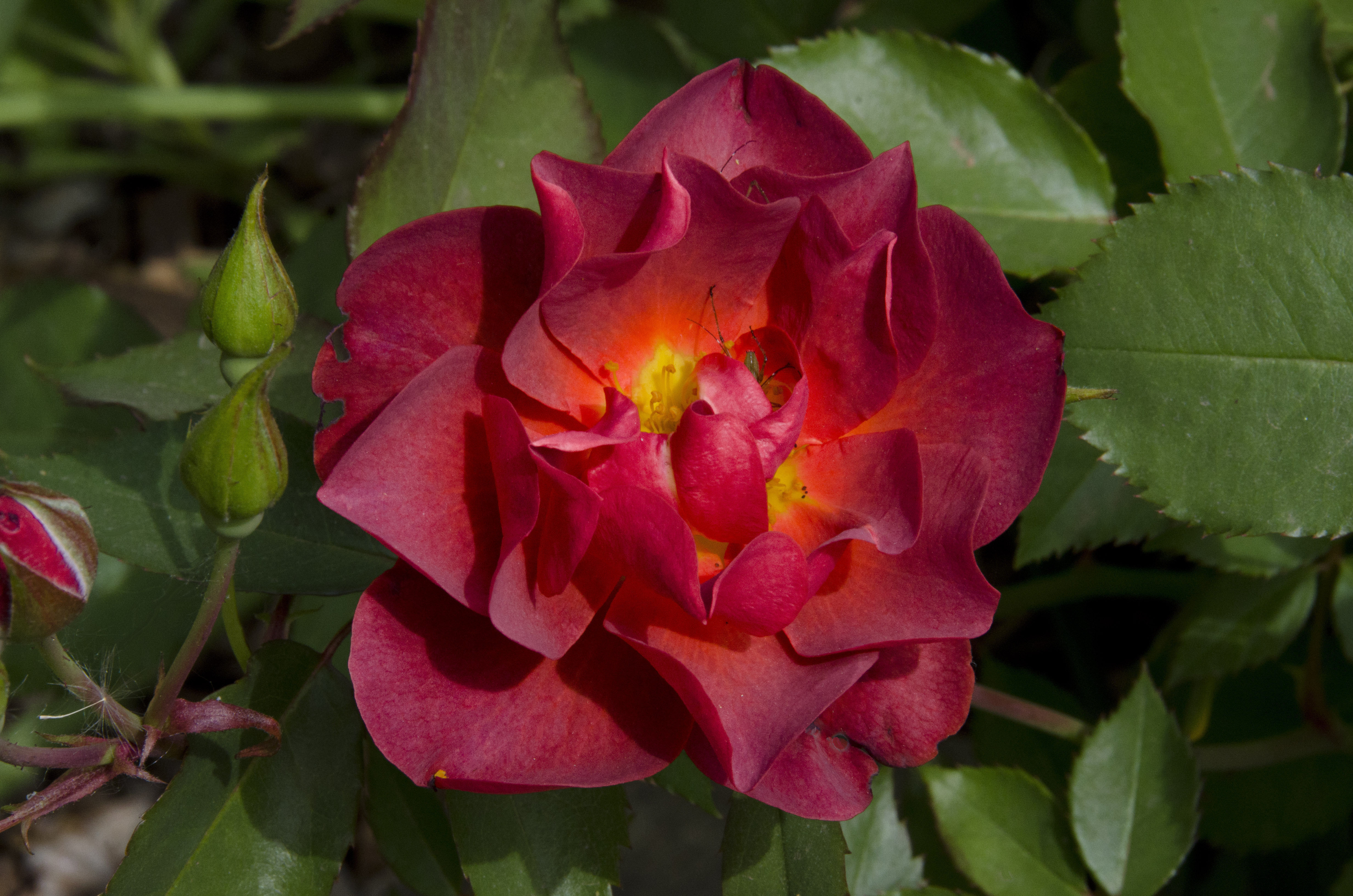
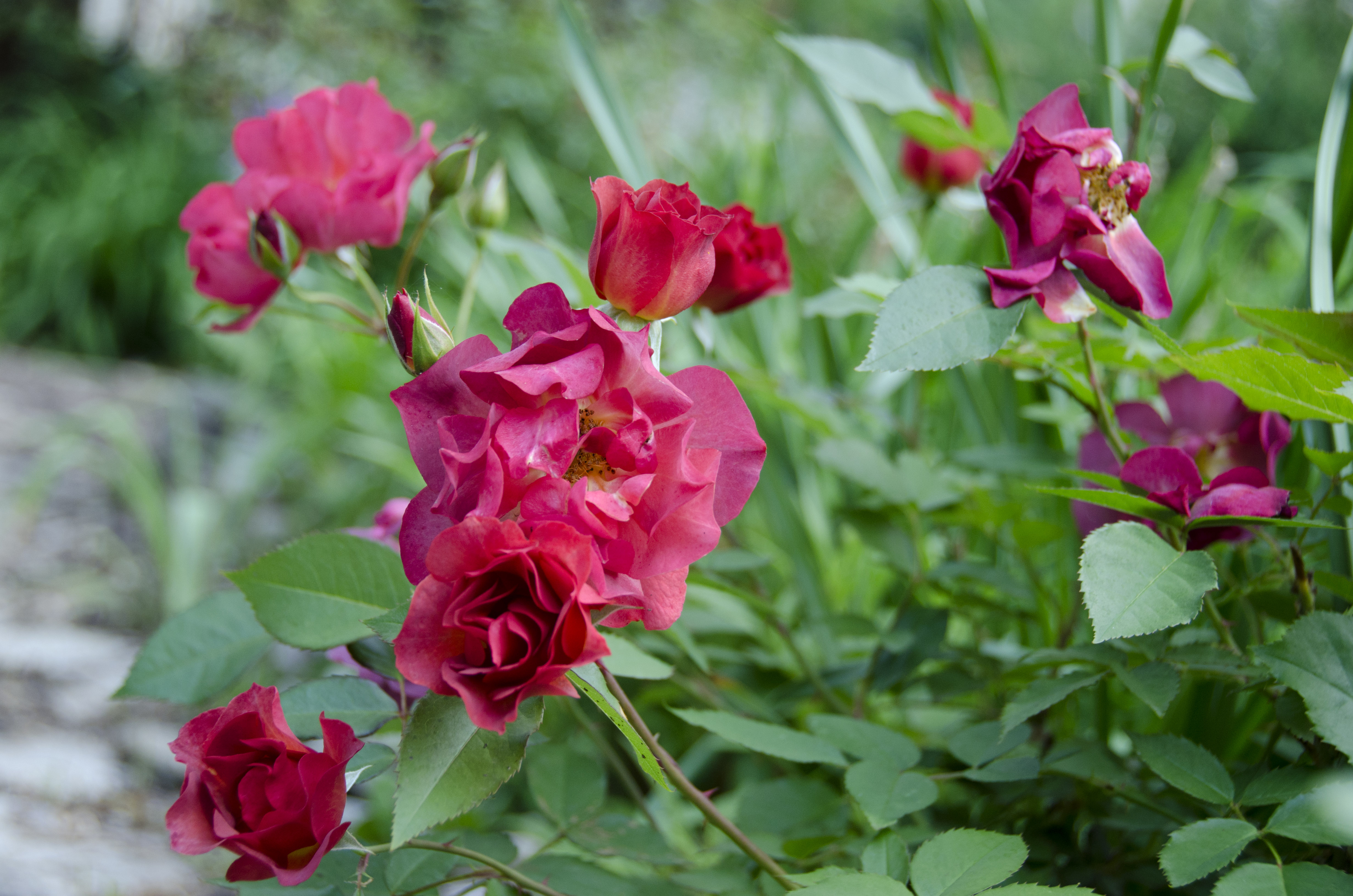
Back in the Autumn, I picked up a Cinco de Mayo Rose on whim. At our old house, where we had originally opened the bed and breakfast, I put in a rose hedge, a rose bed, and some landscape roses. In total, I had around 60 rose bushes, give or take. For various reasons I had decided not to attempt to reproduce that garden when we moved the B & B to this house 12 years ago and instead came up with a completely different garden design. But at times, I found that the three ground cover roses that I planted here just weren’t filling my rosy desires; and here and there, now and then, I’ve had to add more specimens from the genus rosa. Cinco de Mayo was one such planting. I am now seeing it in bloom after its first winter and so far think that it is a very nice addition to my growing collection. The blooms range from a deep purplish-red to coral-pink. Depending on the light, they can look completely different at different times of the day and the color is more intense in cooler weather and when the blooms are new, becoming less saturated in color but no less attractive on warmer days and as the blooms age. One review that I read described the blooms of this All American Rose Selection as “mysterious”. Roses and Other Gardening Joys has a fun post on Cinco de Mayo as well. Ah, so nice to have roses!