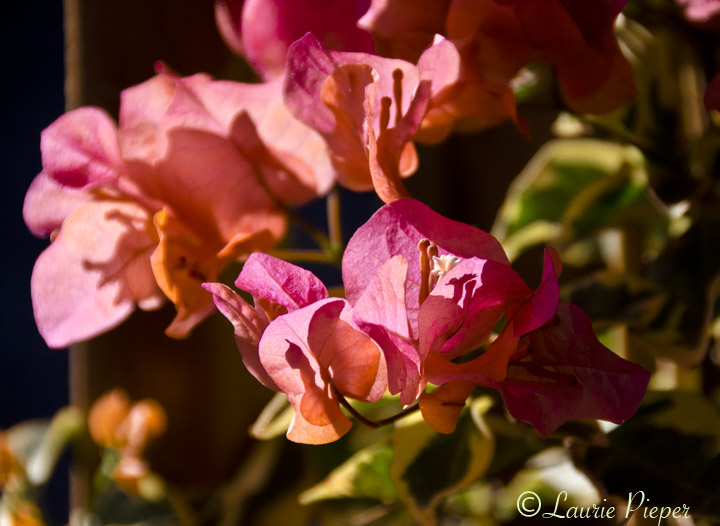
Bougainvillea is rather exotic for this part of the country. So before now, I have not tried growing it in Kansas. Through her gorgeous photographs of these plants, Sofi from Arabica really got me thinking about how much I miss tropical bougainvilleas. When I lived in California, I loved seeing these colorful plants climbing in all kinds of places. So last week I purchased a petite specimen called Bengal Orange at one of our local garden centers. Bengal Orange supposedly only gets to be 18 inches tall but can grow up to 8 feet wide. I planted it in a terra cotta pot and am going to try to train it to grow along our “back porch” – a tiny space off my office where I do container gardening. The bougainvillea is a bright and cheerful addition. Thank you Sofi for the inspiration! I’ve since come across several other posts about bougainvilleas that I have “liked”: Smell the Flowers, Ramblings by Robin Scanlon, Gardening in the Lines, and The Make Shoppe. Here are a few photos of Bengal Orange. Oh, and since pretty Penny was keeping me company while I planted it, I had to include a picture of her too.
Category Archives: Gardening Images & Tips
It’s Scorching Hot: Is it the Weather or the Peppers?
It is scorching hot in Manhattan, Kansas today. It was 97 degrees by noon and 107 in our yard at 5 pm (According to the weather service our official high was 101). So who could ask for a better day to write about hot peppers? In the little container garden on my “back porch”, I grow Chenzo and Burning Bush Habañero peppers. Chenzos have a rating of 45,000 scoville heat units (which is quite hot) while Habañeros are even hotter at 100,000 – 350,000 s.h.u. To put this in perspective, jalapeños rate 2,500 – 8,000 s.h.u.

Burning Bush Habañero Peppers
When I picked my first bunch of Chenzos a few weeks ago, I tied them into a small ristra and hung them off the back porch to dry. It took about two and a half weeks for them to be ready to bring in. Of course, we were having cooler nights then. With our current temperatures, they would probably dry more quickly. I will use the dried peppers in chilis and rubs for grilling.
I decided to do something different with the peppers that I picked today, so I made several bottles of Garlic Chili Lemon Oil. This can be used as a dipping oil with bread or tortillas, can be added to chilis, soups, pasta dishes, and salad dressing. If you decide to make your own flavored oils, be sure to sterilize fresh ingredients such as garlic either by heating them or acidifying them as the oil seals out oxygen and can easily lead to botulism growth. We want everyone to be able to eat safely!
What are your favorite ways to use hot chili peppers? It would be great to hear from you!
A Walkway
Twelve years ago, when we bought our house to turn it into a bed and breakfast, the yard was a mess … almost entirely weeds and dirt. We had originally opened the B&B in a house across the street from Manhattan City Park four years earlier. So when we moved, I wanted our new yard to feel like a miniature park. I got out my graph paper, measured the yard, and came up with a landscape design. Central to the design was a fountain surrounded by a stone walkway. My husband Bill and our friend Jason went to a local quarry and brought back three pick-up truck loads of limestone to build the path. Once it was done, we planted several flats of creeping thyme between the stones. I was so excited. I thought that the walkway looked like it could have been in a magazine.
As Robert Burns wrote, the best laid plans of mice and men oft go awry. The creeping thyme could not hold back weeds. Dandelions, crabgrass, and a whole host of undesirables grew right up through the thyme. In weeding, we always wound up pulling up the ground cover, separating the weeds, then replanting what of the thyme we could – and then planting new thyme the next season. I finally got tired of that cycle and gave up on the interplantings all together. That left us with a stone pathway with just dirt between the rocks. Moreover, the rocks hadn’t weathered well, and many were broken and uneven. The walkway looked antique, as though it could have been constructed when the house was built in 1902; but it was not as attractive as I wished it were and I was always stubbing my toes on it.
It took a couple of years for me to work up the courage to make the call – the stone walkway had to go! This past week, my helper Benjamin dug up the limestone, used it to fortify the border around our central flower bed and to build stone walls on the sides of the property. He then laid down cedar bark mulch which, at least for now, is lovely and so soft to walk on. It gives me happy feet!
Hydrangeas Living on the Edge
At the edge of our next door neighbor’s property, just touching ours, are two hydrangeas. Jean – a previous owner of that property and the woman who planted these bushes – told me that they are Nikko Blues.* To show their intended color, Nikko Blues require applications of acidic fertilizer when they are grown in alkaline soils such as we have in Kansas. Unless the ph of the soil is lowered, the color of Nikko Blues is unstable, ranging all the way over to dark pink. No one fertilizes the bushes next door anymore. Nevertheless, they have a beauty of their own. Unlike their showy true blue relations, these are subtle and sweet-looking, blooming away in the shade. The photos below are ones that I took yesterday. They are all of flower clusters on the same bush.
* To be honest, I am not certain that these are Nikko Blue Hydrangea bushes, though I am inclined to trust Jean. I have been reading up on the subject on hydrangea identification and am thoroughly confused. These are most definitely not Oakleaf, Lacecap or Annabelle Hydrangeas – which leaves Mopheads and Paniculatas. (Nikko Blues are Mopheads.) The leaf formation rules out the Paniculata family; but the flowers open white and then turn a pale pink or blue, which would seem to rule out the Mophead family. Plus they don’t seem to have a full “mophead” – though I suppose this could be due to growing conditions. If anyone has any thoughts on identifying these bushes, I would be happy to know them. We have 6 hydrangeas in our yard, but I don’t consider myself an expert hydrangeas at large. Whether Nikko Blues or something else, I am always happy to see these bushes in bloom.
Crape Myrtles After the Rain
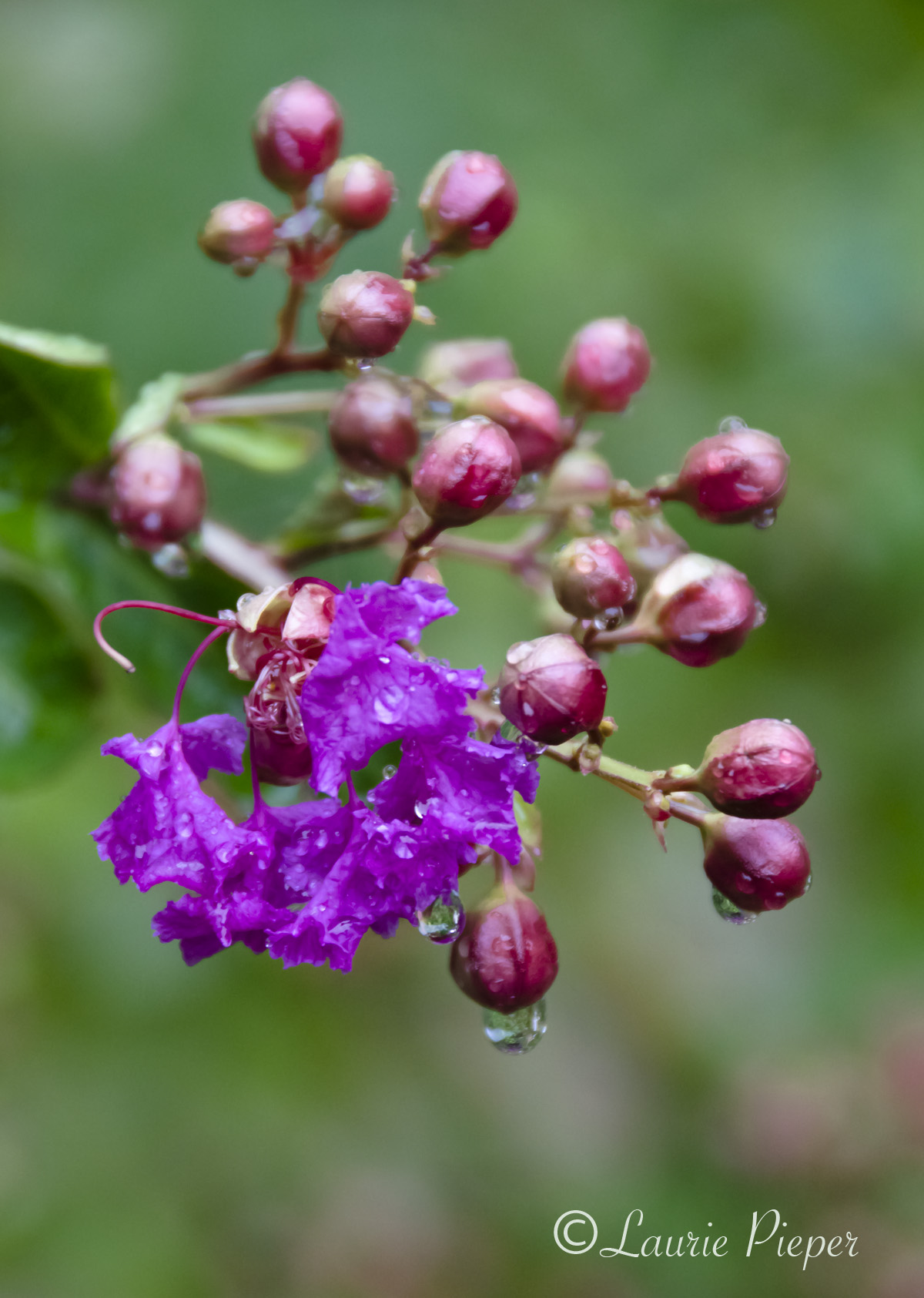
Along with almost everything else in the garden this year, our Crape Myrtles have now started blooming about a month early. After the mild winter that we had in Kansas, the die-back on the Crape Myrtles was almost non-existent. Some years the die-back is quite severe and we have to cut the trees/bushes to the ground. We received 1.27″ of rain last night. This as made everyone happy, especially the farmers, as prior to that we had received only .01″ of precipitation this month. With the garden all wet this morning, I tried to get a couple of pictures. These are of are buds and blooms on Crape Myrtle “Royalty” – one of my favorite plantings.
K-State Gardens
As part of my resolution to experience more of what Manhattan has to offer, I recently attended a gala at Kansas State University Gardens. It was a wonderful evening. The theme was Three Coins in the Fountain to celebrate the installation of a second fountain in the gardens. Unfortunately, I didn’t bring my camera that night, but that just gave me extra reason to go back! The gardens are just over 2 miles from The Morning Star. I hope that you enjoy my photos. (Since the completion of the gardens is still “in progress”, I’ll certainly have more in the future.)
Mystery Blooms in the Garden
As I recently learned from Redneck Rosarian, June is National Rose Month … a perfect excuse to once again write about roses.
I have several ground cover roses in my garden. When I purchased them at least 8 years ago, they were labelled “Red”. In truth, they are more of a magenta. Anyhow, I am quite fond of them. They bloom from mid-Spring through Autumn and add a lot of color to the landscape … and they have proven hardy in Kansas. Now here is my mystery. A few weeks ago, one of the bushes, at the end of one branch, started producing clusters of pale pink roses. At first I thought that I was seeing an errant limb from Flower Carpet Pink, but both the form of the flower and the color were wrong to belong to that other rose. Upon closer examination, I could see that the pale pink blooms were definitely coming from the magenta ground cover rose bush. The flowers on the rest of the branch matched the rest of the bush. What has happened to cause this mutation? Will there be more mismatched roses? Nature is full of mysteries. Fortunately, this is a fun one.
Sometimes Mother Knows Best
I haven’t written in a bit because I took time off to go visit my mother. She lives on a beautiful lake in the Adirondack Mountains.
Growing up, I spent my summers in or on the water whenever the sun was out. It was a wonderful way to spend the days of my youth. However, when my mother would tell me to put on sunscreen, I would think “Why would I wear sunscreen when I want a tan?” and proceed to slather on my spf zero suntan oil. My grandmother would take more radical measures and try to cover me with newspapers when I was lying out on the dock – a habit that irked me as I wound up covered with newsprint. My mother will now confess, however, that when she was a girl, she didn’t heed her mother’s warnings to be careful of the sun either. In fact, at times she would grab a bottle of cooking oil from the kitchen, rub it on her skin and then head out to the beach. Kids did that in those days.
The reason for my visit back East this time around was to help my mother out. She has just endured her third surgery in four months for skin cancer on one of her hands. She has been very brave, but it has been a painful and frustrating time for her. She is healing well, thankfully! She now wears sunscreen spf 50 whenever she goes outside and I too have come to appreciate sun protection. Sometimes we really should listen to our mothers.
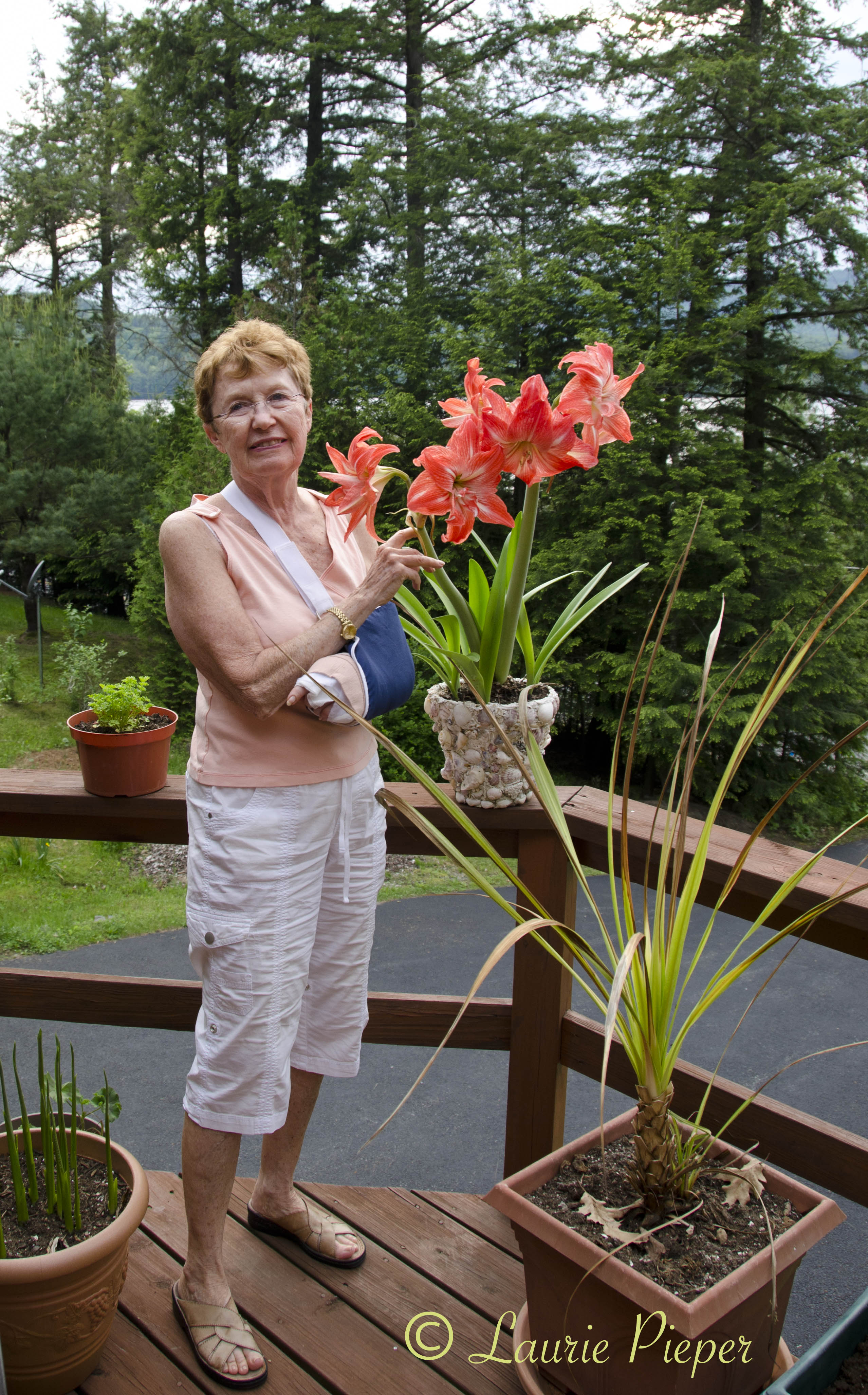
My mother is a gardener. It runs in the family. While visiting Mom, I helped out in her garden – pruning trees, planting annuals, weeding, watering and so forth. Here are a few pictures of my lovely mother and her garden which is just starting to bloom for the season. She can’t wait to get back out and work in it. Soon, Mom : )
Miniature Roses: A Gift for the Garden
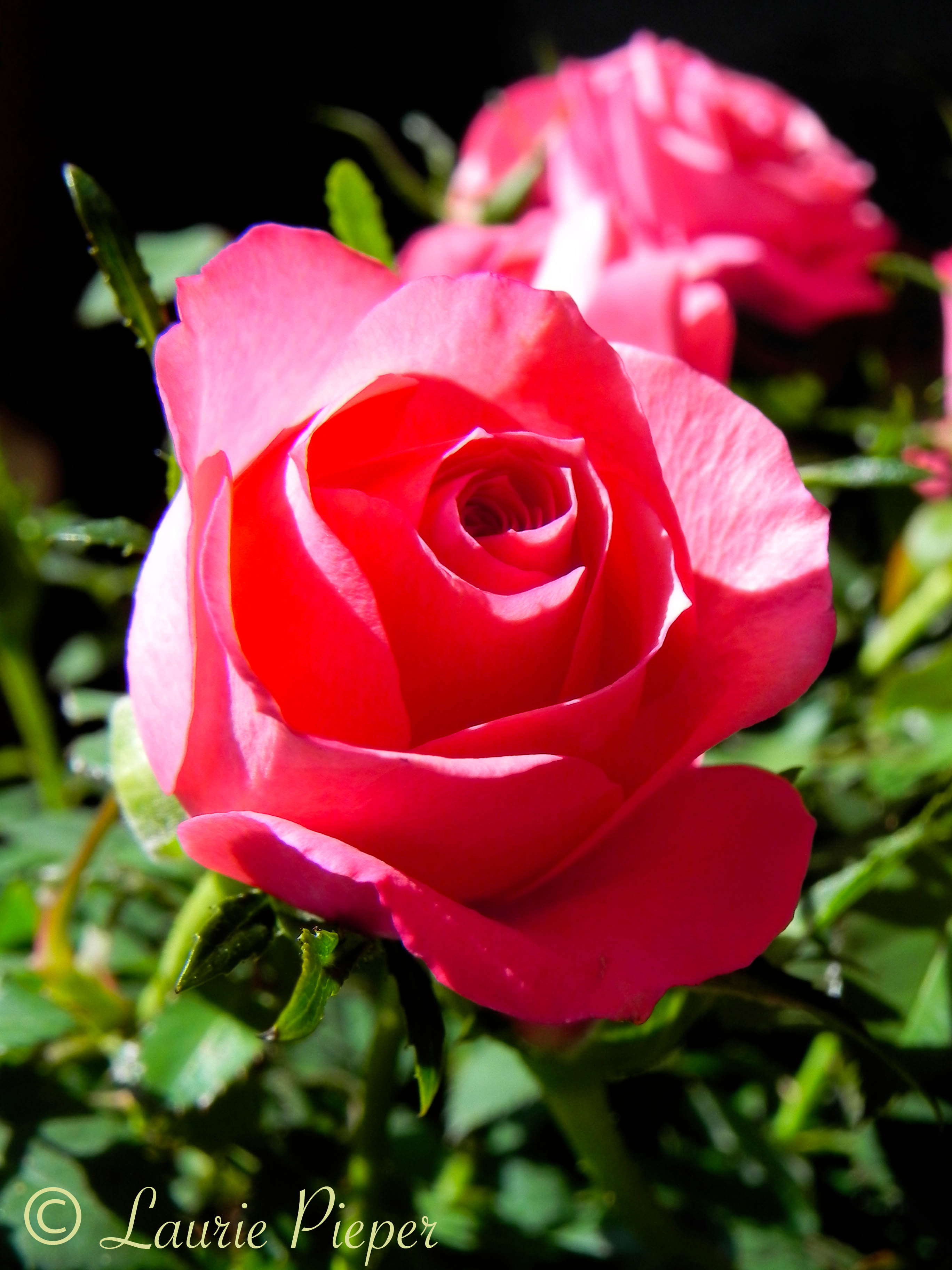
To many, it will come as no surprise that I love roses. However, I am not a rose snob. I love large, elegant, fragrant blooms and can chat away about this and that variety. When I go to a garden center, I have to examine every rose bush and ask all sorts of questions about the growth habits of each variety before I can bring one home. But I also have a penchant for buying those little potted rose plants with the tiny, highly structured flowers that sell in grocery stores for a few bucks around the holidays – a gift for my garden. When I buy them over the winter, I keep them alive inside until I can plant them outdoors in the Spring; and, they have turned out to be surprisingly winter hardy for Kansas. My oldest few have been in the garden for four years now. I have around a dozen grocery-store-bought miniature rose bushes in the garden, give or take, ranging from the most delicate pink to bright coral. I don’t know their names, but that doesn’t matter. What’s in a name?
Memorial Day Rose
Memorial Day will soon be here. Appropriately, we -meaning my helper Benjamin, with me looking over his shoulder, giving instructions, and taking photos – planted an eponymously named rose today. Originally called Decoration Day, a day to honor Union soldiers fallen during the Civil War, in the 20th century Memorial Day became a holiday to honor all American soldiers killed in war. Often, however, people use the day to pay respects to any loved ones who have passed away.
Memorial Day Rose, a 2004 Weeks Rose introduction and AARS winner, is a hybrid tea rose with a strong damask rose fragrance. It’s just heavenly. When I was looking for a rose to bring home to plant, I sniffed every single variety at the garden center. While there were several others – Mr. Lincoln and Fragrant Cloud – to which my nose gave equally high scores, I thought that Memorial Day would look best in the spot that I had picked out. And as I thought about it, I realized that this rose was an excellent selection for more than aesthetic reasons.
My father-in-law, a highly decorated war veteran, recently passed away. So, I think that as members of our family pass by this rose in the garden, the sweet fragrance of Memorial Day may occasion pleasant memories of time spent with Bob.