Chocolate Anisettes

ChocolateAnisettes

Chocolate Anisettes

A variation on traditional Anisette Cookies

Makes about 36 Cookies

3/4 c. + 2 T. all-purpose flour

2 T. Dutch process cocoa

3/4 t. ground aniseed

1/2 t. baking powder

1/4 t. salt

1/2 c. vegetable shortening

1/2 c. confectioner’s sugar

1 lg. egg

1 t. orange extract

Anisette Glaze

nonparaeils to decorate (optional)

1. Preheat oven to 350 degrees F. Line 2 baking sheets with parchment paper.

2. In medium bowl, whisk together flour, cocoa, aniseed, baking powder, and salt. Set aside.

3. In large bowl, beat shortening and confectioner’s sugar until well combined. Beat in egg and then orange extract. Beat in dry ingredients.

4. Scoop dough by rounded teaspoonfuls and place 2″ apart on baking sheets.

5. Bake for about 14 to 16 minutes or until lightly browned. Right before taking cookies out of the oven, make glaze. (Recipe below.)

6. Place baking sheets on a wire rack when you remove them from the oven.  Working one cookie at a time, immediately glaze cookies with Anisette Glaze and then sprinkle with nonpareils, if using decorations.

Anisette Glaze

A citrusy, licorice-flavored glaze.

1 1/3 to 1 1/2 c. confectioner’s sugar

1 t. orange extract

1/4 t. anise extract

2 T. boiling water

1. Place 1 1/3 c. of confectioner’s sugar in a small bowl. Stir in extracts. Gradually stir in just enough boiling water to make a thick, pourable glaze. Stir in more sugar if needed and keep stirring until perfectly smooth.

2. Working one at a time, spoon glaze over warm cookies. If decorating with nonpareils, immediately sprinkle them over glaze. Repeat with remaining cookies.

Getting to Know Italian Wines: The Beginning of a Story

PoggiaAnimaSangiovese

Part I: A Memorable Meal

For years, friends and family told me that I needed to take a vacation. I finally accepted their advice and took myself on a trip to Las Vegas – my goals being to visit family, eat really good meals, and do some Christmas shopping. I actually succeeded in all three of those things!

My first night there, I had dinner at B&B Ristorante, owned by Mario Batali and Joseph Bastianich. Since I was dining alone, I ate at the bar which gave me the opportunity to people watch and chat with other patrons; but more importantly, it gave me the opportunity to discuss the menu and wine pairings with the bartender, Jason. Though I was already familiar with a few Italian wines, I felt a bit lost looking at the extensive wine list. So once I decided what I wanted to eat, I was happy to let Jason chose a selection of wines to go with my meal. (At a really good restaurant, the bartender knows a lot more than just how to mix cocktails.)

I started off with a glass of Ca’ del Bosco Franciocorta Cuvée Prestige – a delightful Champagne-style sparkling blend of Chardonnay, Pinot Nero and Pinot Bianco – then ordered a beet salad and grilled Branzino. To go with the salad Jason poured Bastianich Rosato, a pleasingly crisp, light rosé. To go with the fish, he poured Marziano Abbona Roero Arneis Orchietti – a medium bodied white wine with a gorgeous floral bouquet. After waiting a little bit after the meal, at Jason’s suggestion I enjoyed a plate of dolci with a taste of  two amari: Cardamaro Vino Amaro – a moscato-based liqueur with a sweet start and bitter finish; and then Amaro Ci0Ciaro – a liqueur with bitter orange and herbal flavors. As was my expectation, the food was delicious, each dish being cooked just right and the flavors being perfectly balanced; and the wines and liqueurs were exactly right for the meal.

Part II:  A “Tour” Back Home

When I returned to Kansas, I had a conversation with Chad Lohman, C.S., owner of Nespor’s Wine and Spirits about how much I enjoyed the wines and liqueurs that I had at B&B. Chad suggested that I might appreciate a “tour” of the Nespor’s Italian wines section in connection with thinking about wines for the holiday season. Even though I hadn’t yet starting planning our Christmas menu,  I  certainly thought a tour sounded like a great idea!

Our premise was that Italian wines, like French wines, are made to be enjoyed with a meal and so pair well with food. As we started our tour with a discussion of a Sicilian white wine, we also talked about the fact that white wines are frequently overlooked during the winter because people feel like they don’t want a glass of cold wine. This is unfortunate because white wines often pair more easily with food than red wines, as reds can sometimes be overpowering.  Moreover, white wines lose their interest when they are overchilled, so serving whites in winter shouldn’t be a worry. Rather the concern should be whether the wine goes with the food (or vice versa).

Since I didn’t have a particular menu in mind when Chad and I were having our conversation, we talked mostly in terms of generalizations. One general rule is that  except for with dessert, dry sparkling wines pair well with almost any food. Sweeter foods, on the other hand, require sweeter wines – the sweeter the food, the sweeter the wine. Another guideline is that the heavier the food, the darker and fuller bodied the wine should be. Keeping in mind that the lighter wines in each category would generally go with the lighter foods in that catergory, this guideline would recommend the following:

• white wines pair well with lighter vegetables (e.g. green salad), lighter cheeses (e.g. mozzarella), fish/seafood (e.g. shrimp) and lighter poultry (e.g. chicken);

• rosés pair well with almost everything but especially with richer vegetables (e.g. beets), medium cheeses (e.g. fontina), heavier fish/seafood (e.g. tuna), darker poultry (e.g. duck) and lighter meats (e.g. prosciutto);

• red wines pair well with red sauces, stronger cheeses (e.g. romano), roasted/grilled vegetables or heavier vegetable stews, darker poultry (e.g. pheasant), lighter meats (e.g. ham) and heavier meats (e.g. beef).

These generalizations can then be refined in two ways.

First, it can be helpful to think about both foods and wines in terms of the regions with which they are associated because generally speaking, the wines of each region are made to go with its cuisine.  Pairing foods and wines on a regional basis requires having some knowledge about the various regional cuisines.  For example, consider a seafood dish such Scampi cooked in olive oil with garlic and herbs. This is a dish that is associated with the Friuli-Venezia area, so a white wine from this area would be something one might consider as a complement to the dish.  Chad recommends Villa d’Orvietto (Grechetto, Prociano, and Malvasia) and Ca’ del Sarto Pinot Grigio as nice wines from this region, but suggests avoiding wines coming out of the more industrial areas around Venice.
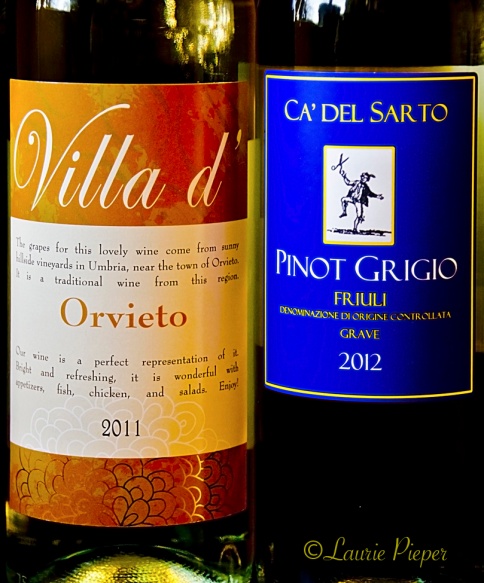
Orvietto&PG2

Another way that one can refine the generalizations that I mentioned above is to think more specifically about the flavors of the dishes that one is preparing (or ordering). For example, is the dish mild, buttery, creamy, earthy, salty, spicy, citrusy, sour, or smoky? To pair wines with the more specific flavors in foods, it is helpful to have more extensive knowledge about particular wines.  One might ask of a wine whether it is light or full-bodied. (Color isn’t always a perfect guide.) Is it fruity, spicy, acidic, tannic, oaky? Is it dry or sweet or something in between? Is it sparkling or flat? Most importantly, the question one will want to ask oneself is, “Do I like this wine?”

For example, I tried three of the whites that Chad had recommended from southern Italy with several different foods. The three that I tried were Ciró Bianco Librandi 21012 (Greco Bianco), Falanghina Feudi di Sangregorio 21012, and Regaleali Bianco Sicilia 2011 (an Inzolia, Cataratto and Greciano blend).
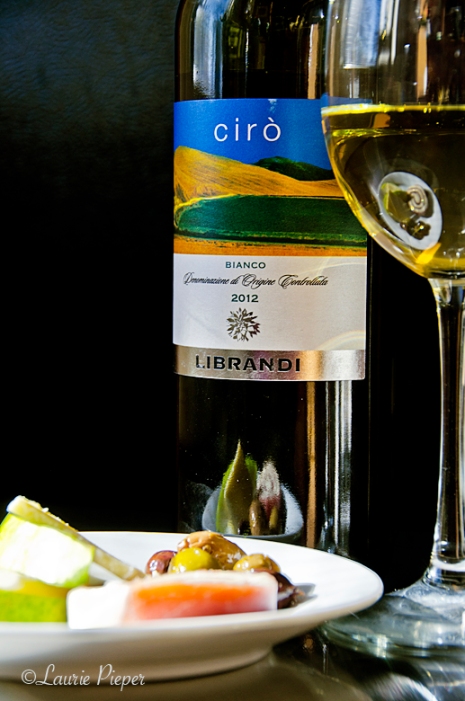
CiroBianco

All were light and crisp, as Chad had said they would be; but the Ciró Bianco Librandi, which I have had several times before, was my favorite.  I thought that it went well with a wider range of foods than the other two, but mostly I enjoyed its flavor more – fruity peach and lightly spicy, without being sweet. The Regaleali was the lightest of the three and went nicely with pears and with smoked salmon canapés. The Feudi di Sangregorio paired well with the olives, but seemed a little bitter with lighter foods.  Mostly, the Librandi just appealed to my taste more than the other two. Enjoying the wine is the point, afterall, which means that no matter how much research one does, ultimately, one has to taste the wine and decide whether one likes it.

Image

Continuing with the tour …  We chatted about the reds (the Barbara d’Astis, Barolos, Barbarescos, Barberas, Dolcettos, and Brachettos) and whites (the Arneises and Asti Spumantes) of Piedmont and also about the Sangiovese-based Chiantis and super Tuscans of Tuscany  – Chad generously sharing his time and knowledge, me reading labels and taking notes.

After, when I went home and started reading about the wines, I felt overwhelmed by all of the grape varieties with which I wasn’t familiar by name (Falanghina, Guillot, Primitivo, Nero d’Avola, Gretchetto, Malvasia, Nebbiolo, and so forth) not to mention the styles of wine between which I didn’t know the differences. Obviously, I had some work to do, if I was going to learn more about Italian wines.  So I went to the library and checked out Vino Italiano: The Regional Wines of Italy by Joseph Bastianich (of B&B Ristorante) and David Lynch. The first section I read was about the difficulty of growing wines in Ciró and one wine that the authors recommended from that region was the Librandi. Ah, confirmation that I was on the right track.

Then it came to me. The tour that Chad had given me really laid out a large project for me to embark upon, if I was up to the task …  getting to know the wines of Italy well enough to converse about them intelligently and to pair them skillfully with food.  And if you know me, you know that this is exactly the type of project that I love.  I’ve tried about 20 Italian wines so far – thank goodness for wine tastings –  and have several good resources that I can rely upon to help guide me further.  Hmmm … I’m thinking that there might be another vacation sometime in my future – perhaps, Italy!

Salute!

Part III: Addendum: A few more of Chad’s Recommendations

Poggia Anima Uriel (white) Grillo

Stemmari 2012 (red), Nero d’Avola 

Amano 2009 (red), Primitivo
 Image

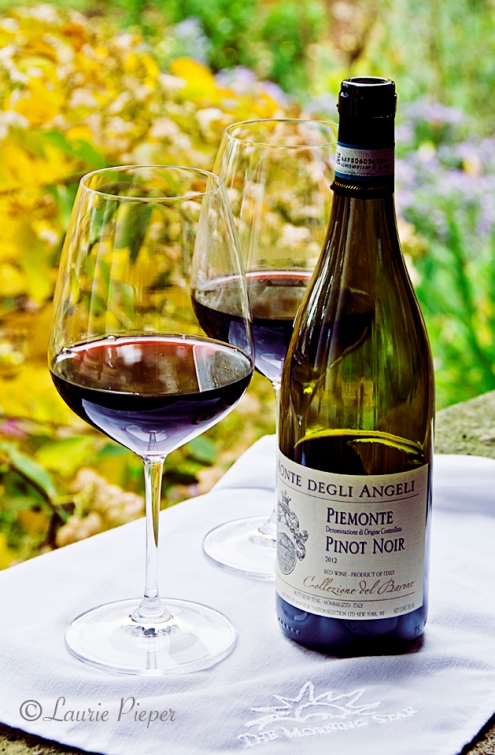
 Monte degli Angeli Pinot Noir 2012 (red)  Pinot Noir

 Produttori del Barbaresco 2007 (red) Nebbiolo

 Poggia Anima Belial 2011 (red) Sangiovese

 Villa Cafaggio 2010 Basilica Single Estate (red)Sangiovese

 Molino di Sant’antimo 2008 Brunello di Montalchio DOCG (red), Sangiovese

Basciano Chianti Rufina 2010 (red blend), Sangiovese, Colorino

Tolaini Al Passo 2009 (red blend), Sangiovese, Merlot

Tolaini Valdisanti 2009 (red blend), Cabernet Sauvignon, Sangiovese, Cabernet Franc

Villa Jolanda Brachetto (sweet red) Brachetto

Thanksgiving Wine Recommendations: An Interview with Chad Lohman, C.S.

Image

    As I mentioned in my last post, Thanksgiving is a month away and already I am preparing our menu. I do love planning a holiday meal! Thinking ahead, I decided to go into Nespor’s Wine and Spirits to chat with Chad Lohman – owner of Nespor’s and Certified Sommelier – about his wine recommendations for Thanksgiving.

Our conversation went like this …

(Me) Hi, Chad, if you have time, I’d love to talk with you about your wine recommendations for Thanksgiving so that I can pass them along to my readers. I don’t want to take too much of your time, but I have a couple of specific topics on which I am hoping to pick your brain.

(Me) First of all, I think that Champagnes are great for serving with special meals because they go well with so many different types of food.

(Chad) I agree, but unfortunately a lot of people don’t realize that Champagnes, Proseccos, and Cavas – basically, any good sparkling wine – are great for serving at holidays because they do go so well with food. We have a Cava from Spain that we are recommending for Thanksgiving this year. Naveran Cava Brut 2010 ($16.99), which was given 90 points by Robert Parker’s Wine Advocate, is a nice neutral sparkling wine for pairing with foods.

(Me) Since not everyone appreciates sparkling wines, what would you recommend for a white wine to serve with Thanksgiving dinner?

(Chad) For holiday meals where there are so many different flavors on the table, it is a good idea to have a wine that works well with a lot of foods rather than trying to pair a wine with every dish. Also, you want something that is accessible to different palates. An off-dry Riesling or Gewürztraminer – but not the sweeter varieties – would perform well in this role. You want something that is lightly sweet, but has good acidity. A couple of recommendations would be Alsace Willm Riesling and Hook & Ladder Gewürztraminer ($19.99).

(Me) Oh, yes, I purchased some of the Hook & Ladder around this time last year. It’s not too sweet and has a bite of grapefruit in the finish. I remember liking it with food, but that it wasn’t what I would consider a sipping wine.

(Chad) Right. For a sipping wine, I would go with a Sauvignon Blanc or Chardonnay.

(Me) … something like Rodney Strong Charlotte’s Home Sauvignon Blanc ($19.99)

(Chad) … which is a classic Sauvignon Blanc, or Honig from Napa Valley which is Cabernet country.

(Me)  Thanks. Sorry, I digressed. So, getting back on topic, I am quite happy to drink white wines with Thanksgiving dinner, but I know that we have some friends who don’t like white wines. I briefly considered serving a dry rosé from France, but thought that would be too light to hold up to most of the foods on the table; and someone who doesn’t like white wines, probably isn’t going to like a rosé anyway. Do you have any reds to recommend for me?

(Chad) A darker colored dry rosé – not a sweet White Zin – should hold up ok. Les Lauzeraies Tavel 2012 ($15.99) is a dry rosé with more body and would go with a Thanksgiving ham, for example. For reds, a Pinot Noir or Gamay Beaujolais would pair nicely with Thanksgiving dishes … and, of course, there is always Beaujolais Nouveau which comes out around the 3rd week of November.

(Me) Right. I usually have a Beaujolais Nouveau for one of our Thanksgiving selections. It is very light and as you put it, “accessible”; and also is a traditional selection for the time of year. But if I wanted to serve a Pinot Noir or Gamay Beaujolais, what would be your recommendation?

(Chad) We have two Pinot Noirs that we are recommending right now: Monte Degli Angeli 2012 ($12.99) and Lomas del Valle 2012 ($14.99).  The Monte del Angeli is more earthy and has a softer mouth feel. The Lomas del Valle ($14.99) has more of a big fruit, big (alcohol) mouth feel.

(Me) In my November (Thanksgiving) newsletter, I am including a recipe for Chanterelles Risotto with Truffle Butter.

(Chad) The Monte del Angelli should go nicely with the earthy flavors of the Chanterelles and truffles.

(Me) Now what about dessert? I’ve served dessert wines a few years and they don’t seem that popular at Thanksgiving. Everyone is pretty full by then, of course. I’m thinking about maybe having a brandy for after dinner instead.

(Chad) My recommendation would be a Ruby Port or a Tawny Port, but not a Vintage Port. Now with ports, you are going to want to avoid the inexpensive ones. Which do you think you would prefer? Tawny ports are going to have a little bit more of a nutty flavor. Ruby ports will be a little fruitier.

(Me) Let’s try a ruby.

(Chad) Nierpoort Ruby is actually not a bad price ($19.99) and would be nice for after dinner. Serve it at about 50 degrees Fahrenheit, around the same temperature that you would serve a rosé.

(Me) Great. Sounds like we have some good ideas. Thanks, Chad!

Image

Chanterelle Risotto with Truffle Butter

If you are like me, you start planning your Thanksgiving menu a month in advance. Chanterelle Risotto with Truffle Butter is a dish that I like to prepare around the holidays, because it is deliciously rich and decadent.  So I thought that I would post this recipe early to give you time to consider including it (or some variation) in your holiday planning. (In the U.S., Thanksgiving is one month from tomorrow – but no pressure!) Buon appetito! Image

Chanterelle Risotto with Truffle Butter

makes 6 first course servings

1 oz. dried Chanterelle mushrooms

hot water

1 1/2 T. extra virgin olive oil, divided

1 small yellow onion, diced

1 c. Arborio rice

2 oz. dry white wine or Scotch*

3 c. chicken or vegetable broth

crushed hot red pepper**

2 slices cooked duck bacon, chopped (omit for a vegetarian risotto)

1/3 c. freshly grated Parmesan cheese (loose, not packed down)

2 – 3 T. truffle butter

1. Wipe or rinse any grit off the Chanterelles. Place mushrooms in a small bowl, cover with hot water and soak for about 20 minutes. Reserving the liquid, strain the mushrooms. Strain the reserved liquid into the chicken or vegetable broth. Chop mushrooms. Set aside.

2. Place a large skillet over medium heat. Add 1/2 T. of the olive oil, then swirl oil around pan. Add onion and cook, stirring frequently until tender and almost translucent. Remove onion from skillet. Add the remaining 1 T.  olive oil and rice to skillet. Stirring frequently, cook until the rice is evenly coated with oil and starts to turn golden. Stir in the wine or Scotch. Allow the rice to cook until the liquid is almost entirely absorbed. Meanwhile, in a medium pan, heat broth until simmering. Cover and keep it at a simmer until you have finished cooking risotto.

3. Raise the temperature under the skillet to about medium-high. Add enough broth (about 1/2 c.)  to cover bottom of skillet. The skillet should be hot enough to allow the broth to keep simmering. Stir occasionally.  Continue the process of adding small amounts of broth and letting the rice absorb the broth.  When rice is about half-cooked, stir in mushrooms and onions. Continue adding broth and cooking rice, until the rice is almost cooked and the broth is almost absorbed. (If you run out of broth, simmer a little water to finish recipe.)

4. Shortly before rice is done cooking, sprinkle lightly with hot pepper, then stir in duck bacon.*** Add a hunk of truffle butter to risotto. Stir vigorously to melt and to distribute evenly. Stir in freshly grated Parmesan cheese until melted. Taste. Adjust seasonings (salt, pepper, cheese) if necessary. Serve immediately.

Notes:

* Scotch is not traditionally used in making risottos, but the flavor blends well with the mushrooms and duck bacon and does not overwhelm the truffle butter. For a more traditional risotto, use white wine.

** How much pepper you should use depends on your pepper. I usually use crushed, dried Chenzo peppers from my garden,  which are very hot, and I only use about 1/8 t. You want to use enough so that there is just a faint heat to the flavor of the dish. Err on the side of adding too little pepper. You can always add more when you adjust the seasonings.

*** When the risotto is finished, the rice grains should be just somewhat tender but still distinct in shape and texture – and definitely not mushy. Recipes often call for risotto to be al dente, but I find that sometimes people undercook the rice in an effort not to overcook it. The rice should be creamy not crunchy. Keep in mind that for a short while, the rice will continue cooking from the heat of the risotto. Achieving the proper degree of doneness might take a little practice.  A finished risotto should be a bit loose and jiggly in consistency, but not runny or liquidy.

Happy Labor Day!

Happy Labor Day! I hope that you have a chance to kick back and relax. I’ll be working today, but that’s o-kay. We have some lovely guests staying with us and when the day is over, I plan to have a nice cold Root Beer Float!Image

4th of July Cheesecake Cupcakes

Image

An easy to make, fancy treat for the upcoming holiday!

Cheesecake Cupcakes

makes 12

12 Oreo cookies or Oreo Golden cookies

16 oz. cream cheese, softened

2/3 c. granulated white sugar

1/4 c. sour cream

2 lg. eggs

1 T. + 1 t. fresh lemon juice

2 t. vanilla or almond extract

whipped cream for topping

fresh strawberries, raspberries and/or blueberries

1. Preheat oven to 375 degrees F. Line a 12-cup muffin pan with muffin papers. Place one cookie in the bottom of each muffin paper.  (The cookies will be a little smaller than the bottom of the muffin cups, but they puff out during baking.)

2. Using a large food processor or an electric mixer, process or beat cream cheese and sugar until perfect smooth. Add sour cream and process or beat until well blended. Add eggs, lemon juice, and extract. Process or beat until well blended and perfectly smooth. Divide cheesecake batter between muffin cups, filling until almost full.

3. Bake for about 20 minutes or until puffy and set in the middle. Remove from the oven and cool on a wire rack. (The cupcakes will sink in the middle as they cool.) Once completely cool, cover with plastic wrap and refrigerate for at least 3 hours before serving.

4. When ready to serve, lift cupcakes out of pan, remove muffin papers, top with whipped cream and fruit. Enjoy!

Notes: The cheesecake batter is the same batter that I use for my Miniature Cheesecakes in Confectionately Yours. Either recipe can be made ahead of time and frozen until shortly before serving, then decorated at the last minute.

Roasted Pheasant, A Christmas Present

When you are running low on ideas for what to get someone for a present, it can be nice to prepare a special meal for that person. For an early Christmas present, I decided to cook Roasted Pheasants as a lunch for my husband and my mother. This was the first time that I had ever cooked game birds and so I am not going to pretend to be an expert on their preparation. I had to do a little searching for information on temperature and times. I mostly followed the recipe from Hunter Angler Gardener Cook.*

I started out with wild Scottish pheasants and  brushed them with extra virgin olive oil, sprinkled them with sea salt and fresh-ground black, green, and pink peppercorns. I then added slices of lemons and leeks to the pan, drizzled them lightly with olive oil and topped the pheasants with a bit of fresh rosemary from my snow-covered garden.

PheasantBeforeCooking

RosemaryInSnow2

While the birds were roasting, I prepared a leek and broccolini risotto. The flavors of lemon, leek and rosemary blended quite well with that of the wild pheasants. After lunch, Bill and Mom were too full for dessert, but we sat around anyway and had an interesting conversation.

PheasantRoastedSharing good food is a great way to bring people together, particularly when one puts the thought and effort into making a special meal.

Happy Holidays!

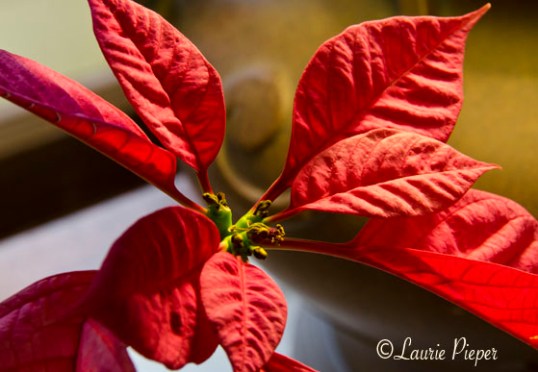
Poinsettia Leaves

Poinsettias can add cheerful color  to a house around the holidays. I have a beautiful bushy dark red one that everyone loves. The photo below, though, is of a scrawny pinkish one that I purchased solely because I liked its color. Initially I had buyer’s remorse. Afterall, who buys a skinny poinsettia? A skinny poinsettia is like a skinny Santa. I found new appreciation for this little plant, however, once I started photographing it because its sparse form allows the individual leaves to really show. Happy Holidays!

PinkPoinsettiaLeaves

Happy Reindeer Daiquiri

In my previous post, as part of the Two Little Chefettes’ Cooking Challenge, I published a recipe for Brown Sugar Cinnamon Syrup. One way to use this syrup is in cocktails and mocktails in place of plain simple syrup. Brown Sugar Cinnamon Syrup imparts rich cinnamon and caramel flavors to drinks.  The Happy Reindeer Daiquiri is an excellent example. Cheers! Happy Holidays!

Happy Reindeer Daiquiri

2 oz. rum (or apple juice, for an alcohol-free drink)

1 oz fresh lime juice

1/2 – 1 oz. brown sugar cinnamon syrup, or to taste (recipe)

Maraschino cherry

Cinnamon stick

Pour rum, lime juice, and brown sugar cinnamon syrup into a cocktail shaker filled with ice. Shake well. Strain into a coupe or martini style cocktail glass. Garnish with Maraschino cherry and cinnamon stick. Serve immediately.

HappyReindeerDaiquiriCheers!

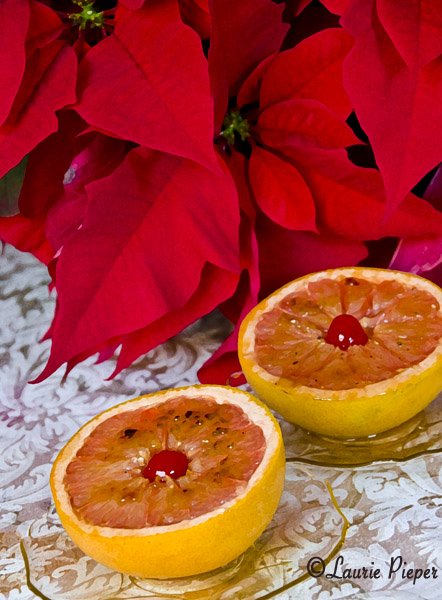
Caramelized Grapefruit

Caramelized Grapefruit

An elegant yet easy to make fruit dish for holiday brunches …

1/2 c. light brown sugar

1 t. ground cinnamon

2 lg. red grapefruit

4 large grapes or maraschino cherries

Preheat oven broiler. In a small bowl, mix together brown sugar and cinnamon. Set aside. Cut grapefruits in half crosswise. Use a grapefruit knife to section the grapefruits and to remove centers. Sprinkle brown sugar onto each grapefruit half. Place grapefruits 6 inches under broiler and cook for about 5 minutes or until brown sugar is melted. (Watch grapefruit carefully during this time.) Remove from broiler. Place in dessert bowls or on dessert plates. Put a grape or cherry in the center of each grapefruit half. Serve immediately.

Note: If you do not have a broiler, you can use a chef’s torch to melt sugar. If you do not have a chef’s torch, let the sugar soak into the grapefruit for about 10 minutes before serving. The sugar will not caramelize, but the flavor will still be pleasing.